Pages

March 24, 2009

Boxee v. Hulu: Endgame

For those of you who haven't been following - In this corner: Boxee's a very nice media center type "10 foot" UI for watching video content (local and internet) using your PC/Mac. In the red trunks: Hulu's a "free" browser based video service backed by NBC/Universal and Fox.

Round 1: Boxee's supports Hulu in Boxee and goes from "nice" to "useful/interesting"
Round 2: Hulu asks Boxee to drop Hulu support. Boxee complies.
Round 3: Sort of.  Its not supported out of the box(ee :)), but Boxee lets users manually add Hulu support.
Round 5: Boxee adds a browser.  (Mozilla/Firefox - read through the post)

Now it gets interesting...

So... much like the machinations of ESPN, the real question is why? 

It's not entirely clear to me - and Boxee's end run should bring it to a head;  If I connect a browser to my TV, why shouldn't I be able to play content that works on my PC?  As a practical matter, there's no good way to differentiate (in the medium term - short term hacks might work)

I kind of get the point for the content guys - they want to decide how and where their content gets consumed.  Here's the thing - they may not get that choice: free is free.

(Incidentally this is less of an issue for folks like us than you may think: either way its over our connectivity, and content aqcuisition is a big part of our costs - think it through.  For example, note that Netflix likes streaming - because they charge you a subscription.)

It seems like the issue is that, ultimately, the Internet will erase a huge amount of value (valuation?  perhaps not quite the same thing) from the world.  I'm not arguing about whether that's a good thing or a bad thing - arguably, this was artificial value.  Just saying its so... question is how you adjust.

February 12, 2009

ESPN makes an... interesting play

I'm surprised there's not been more coverage of ESPN's ISP extortion scheme.
ESPN's Play To Make ISPs Pay
(from slashdot)

Its kind of interesting - on the one hand, its their site, their content, they should be able to do what they want... on the other hand, well, it seems like deals like this seem like a bad idea on many levels. I guess the markets will speak on whether this makes sense.

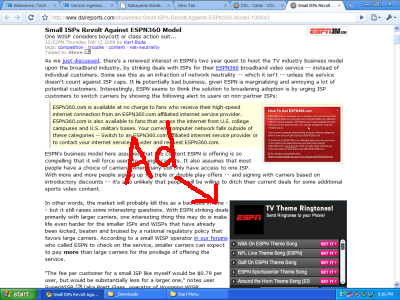
But amusingly, this was also covered on BroadbandReports (see here) - the amusing part is that the article ran with an advertisement (contextually served by our overlords at Google) from, you guessed it, ESPN.


Karma's a fickle beast.

February 2, 2009

Twitter, really? You're surprised?

I'm always a bit surprised at the media's surprise of media darlings (to wit: "Twitter's Risk of Ubiquity"). First, we're all lemmings - where "all" especially includes anybody who thinks they are a subject matter expert, analyst, or pundit.

Secondly (specific to this instance), Twitter is Second Life for the "cool" geeks (what's the emoticon for sarcasm?). Which is to say, though not as nerdy as 3D, it is an interesting indicator of future interaction patterns ("follow the alpha geek"). But, its never going to be a interesting business, and the early pioneers will likely not stand the test of time.

An ex-VP of Business Development of one of my endeavors once said "Our goal is to have a business model that you can't disprove in a finite amount of time." (I probably should have listened to him - but that's a story for another day)

So here's my new axiom for the new economy (I'll warn you in advance that its not as pithy as my former colleague's):

If you have a Chief Revenue Officer, you might be a jack-ass.

The business of EVERY business is to make money. Seriously. Its right there in the definition and everything.

December 19, 2008

Redux: Touch UI and the Art of Intent

Some very interesting research into touch UI from Microsoft Research, University of Toronto, and the good folks at Mitsubishi (MERL's been doing some great work) illustrates how to improve the precision and efficacy of touch screen computing. This isn't strictly a technology problem (touch screens are pretty accurate) - its a human factors problem (an affordance issue).

I wrote on this a while ago - the mouse is pretty accurate, but one of the significant reasons I think it succeeded as an "intuitive" input device was that it created an interface paradigm that allowed "intent".

Touch screens allow us to create programmable input devices (the hardwares becomes "soft" - the rest is just wiring) - I don't think its tactility that's makes it intriguing.

While the article posits that they solve the "fat fingering" problem by allowing the interactive to happen "above" your fingers - that is, you can touch the front *and* back of the screen, I'll posit that its actually the recapturing of *intent* in the interaction flow that makes the difference here.

Judge for yourself:


In any case, pretty cool.

December 10, 2008

I've seen the future!

Not so much.

Microsoft Plans VR Simulation of Everything? (from slashdot)

"Microsoft's research chief has been
promoting the idea of commerce applications and other tools built on top of what he calls the 'Spatial Web', a blend of 3D, video, and location-aware technologies. He gave an example of a shopkeeper creating 3D models of his store's interior and goods with Photosynth and then uploading the results into a large 3D model of local shopping district. Customers could 'visit' the area, browse products, and order them for real-world delivery"

As a colleague of mine once said, quite some time ago:
"Sounds like Doom, without the fun"


(Or... was that me? Can't remember....)

December 9, 2008

Review: Best Javascript book EVER.

Douglas Crockford's "Javascript: the Good Parts" - go get it. Its concise, and takes you through the semantics of Javascript from first principles. Unlike most such books, which try to make learning JS easier by over-analogizing to other languages, Doug's book also highlights the differences from the very beginning - building a much better foundation for understanding the language, pros and cons.

Heartilty recommended regardless of your level of sophistication or intimacy with Javascript. At a minimum, you'll come away with a better framework for approaching your web applications. And if you're language geek, you'll just like it.

Plus, its concise.

Probably my favorite programming book since
the red book (level 1, natch).