Pages

May 20, 2009

Browser benchmarks: When did they get so stupid?

So, the claim that IE is faster than Firefox, Safari, or Chrome, is ridiculous at many levels (MS claims IE faster than other browsers), and Microsoft was appropriately ridiculed for it.

But so is the idea that you have a test that demonstrates that the new Safari builds are "above 15 times better performance than Internet Explorer 7 in the same system".

Seriously, that's just stupid., and renders the index meaningless.

Why not just multiple the index scores by 10? Then you can claim Safari is 150X faster than IE7.

Without scaling the index into a range that meaningfully communicates (or at least correlates) to user experience (which things like FPS and even 3DMark did for video cards), it renders the testing both invalid and irrelevant.

May 15, 2009

Comscore v. Hulu: garbage in---garbage out?

Interesting. The New York Times is reporting that Hulu is disputing audience count with Nielsen, stating "While Nielsen reported 8.9 million visitors to Hulu in March, another measurement firm,comScore, counted 42 million. "

Wow.

Slightly embarassing, but I think that the Times is confusing "Unique Visitors" (how many unique cookies are counted by a site - a reasonable proxy for people visiting the site) with "Unique Viewers" (a syndicated video player concept - how many unique cookies were counted by the syndicated player; a reasonable proxy for the number of viewers who were served video by the site).

In layman's terms, the first number would represent, in our example, the number of people who visited Hulu.com (unique visitors), while the second (unique viewers) would represent how many people watched a Hulu sourced video, whether on Hulu, a third party site (like Fancast), or embedded elsewhere (like on somebody's blog).

A visit to alexa or compete shows the number of "unique visitors" to be comparable to what Nielsen reported (a fact others have noted). And guess what? Even Comscore doesn't put Hulu in the top 50 for April 2009 - which means even Comscore suggests that the number of unique visistors to Hulu is less than 19M (if someone has the actual number, I'd appreciate it).

So... move along... nothing to see here...

April 26, 2009

Wow - what am I missing?
Pirate bay craziness...

http://www.nme.com/news/various-artists/44103
The pirate bay is (was?) a site that holds *links* to torrents.  I'm NOT in anyway in favor of copyright violation or intellectual property theft - but how is this (a) wrong or (b) worthy of the punishment?  ($M in fines, and time in *prison*)??

Its a search engine?  It doesn't hold the content.... perhaps I'm missing something (have to admit I never used it).

Update: hiliarious (and accurate) thepirategoogle (pirate bay using google... duh, its a search engine, just like thepiratebay was)
Update 2: hmm - broken (blocked by google?)
Update 3: An update (tried to find the site owner, but couldn't)... so try this: thepiratebaygoogle on sree

March 24, 2009

Boxee v. Hulu: Endgame

For those of you who haven't been following - In this corner: Boxee's a very nice media center type "10 foot" UI for watching video content (local and internet) using your PC/Mac. In the red trunks: Hulu's a "free" browser based video service backed by NBC/Universal and Fox.

Round 1: Boxee's supports Hulu in Boxee and goes from "nice" to "useful/interesting"
Round 2: Hulu asks Boxee to drop Hulu support. Boxee complies.
Round 3: Sort of.  Its not supported out of the box(ee :)), but Boxee lets users manually add Hulu support.
Round 5: Boxee adds a browser.  (Mozilla/Firefox - read through the post)

Now it gets interesting...

So... much like the machinations of ESPN, the real question is why? 

It's not entirely clear to me - and Boxee's end run should bring it to a head;  If I connect a browser to my TV, why shouldn't I be able to play content that works on my PC?  As a practical matter, there's no good way to differentiate (in the medium term - short term hacks might work)

I kind of get the point for the content guys - they want to decide how and where their content gets consumed.  Here's the thing - they may not get that choice: free is free.

(Incidentally this is less of an issue for folks like us than you may think: either way its over our connectivity, and content aqcuisition is a big part of our costs - think it through.  For example, note that Netflix likes streaming - because they charge you a subscription.)

It seems like the issue is that, ultimately, the Internet will erase a huge amount of value (valuation?  perhaps not quite the same thing) from the world.  I'm not arguing about whether that's a good thing or a bad thing - arguably, this was artificial value.  Just saying its so... question is how you adjust.

February 12, 2009

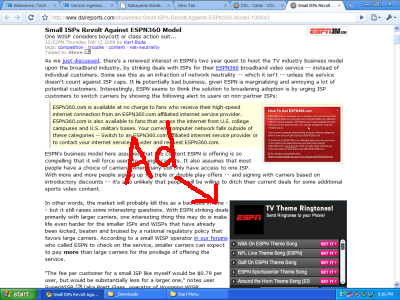
ESPN makes an... interesting play

I'm surprised there's not been more coverage of ESPN's ISP extortion scheme.
ESPN's Play To Make ISPs Pay
(from slashdot)

Its kind of interesting - on the one hand, its their site, their content, they should be able to do what they want... on the other hand, well, it seems like deals like this seem like a bad idea on many levels. I guess the markets will speak on whether this makes sense.

But amusingly, this was also covered on BroadbandReports (see here) - the amusing part is that the article ran with an advertisement (contextually served by our overlords at Google) from, you guessed it, ESPN.


Karma's a fickle beast.

February 2, 2009

Twitter, really? You're surprised?

I'm always a bit surprised at the media's surprise of media darlings (to wit: "Twitter's Risk of Ubiquity"). First, we're all lemmings - where "all" especially includes anybody who thinks they are a subject matter expert, analyst, or pundit.

Secondly (specific to this instance), Twitter is Second Life for the "cool" geeks (what's the emoticon for sarcasm?). Which is to say, though not as nerdy as 3D, it is an interesting indicator of future interaction patterns ("follow the alpha geek"). But, its never going to be a interesting business, and the early pioneers will likely not stand the test of time.

An ex-VP of Business Development of one of my endeavors once said "Our goal is to have a business model that you can't disprove in a finite amount of time." (I probably should have listened to him - but that's a story for another day)

So here's my new axiom for the new economy (I'll warn you in advance that its not as pithy as my former colleague's):

If you have a Chief Revenue Officer, you might be a jack-ass.

The business of EVERY business is to make money. Seriously. Its right there in the definition and everything.