#ihatewhengirlsay "Twitter's going to make tons of money."
September 12, 2009
#ihatewhengirlssay "that didn't take long"
Interesting to watch "tweetalanches" happen... and where/when they get started. For example, today at 10am, "#ihatewhengirlssay" was not a hashtag with any tweets. At the moment .... a few hundred. It should be interesting to see how much "damage" it causes before the dust settles. The whole things reminds of Scott Adams' "Avatar" concept/character in his most excellent books: God's Debris and Religion War (no relation to James Cameron's upcoming movie).


June 25, 2009
Comcast, Time Warner, and TVEverywhere
Comcast and Time Warner jointly announced the "TV Everywhere" initiative - much to the very vocal derision of blogs, pundits, and digital heads everywhere :)
The root of the announcement is, of course, that premium programming content will be available online, at no incremental cost to consumers (what marketers like to call "free" :)).
Hard to see why this is a bad thing - but there are lots of big words, like "anti-competitive" and "anti-consumer", being bandied about, so let's try to deconstruct the questions being asked a bit. Note that opinions expressed here, as always, are strictly my own.
1) Should content producers allowed to charge for access to their content?
I think the answer to that is "yes". There are some fair questions about who they charge, and how, and is there pricing collusion, etc. - but I don't think anyone means to imply that advertising is the ONLY model that content producers should be able to use?
So... broadcasters (NBC, ABC, Fox, et al) ALREADY make the content available for free (over-the-air) - and they monetize with advertising. The "Hulu model" was to take the same business model, and make it available online. I don't mean to parse semantics here, but... kinda sounds like the same idea here: make content available wherever consumers are, using a model that is already working for consumers. Like Hulu, this isn't a new business - its a new distribution channel.
Hmm - not sure I follow this one. "TV Everywhere" is not exclusive in any way - its simply a way for premium TV producers to get their content to consumers online, and helps identify those who are already paying for the content offline. If the content producers want to make their stuff free - well, it is their content; they're welcome to do so - not sure how this initiative impedes that idea. Yes, NBC, Fox, et al, already make their content available free to consumers (for a limited time window) - but also did so before Hulu.
The Internet is an "all bits are equal" data pipe into the home - and nothing about offering subscription video over the Internet with "TV Everywhere" changes that?
The irony, to me, of posts like Om Malik's (about the "inefficent business model" being propagated here, etc.) is that it sits on the site the same day as a post that reads "Is there a future for original web video shows?"....
There is a fair question here - will the price to consumers of content trend towards zero? And if it does, how will that impact quality (i.e. who's going to want to pay to make the good stuff)?
This program doesn't purport to answer that - mostly its just trying to get more people more convenient access to something they're already paying for.
How horrible! :)
June 1, 2009
MS Bing: The more things change...
Microsoft launched their new search engine (Bing) today. Its nice, though, as a friend on Twitter pointed out, it does have that "Microsoft smell".
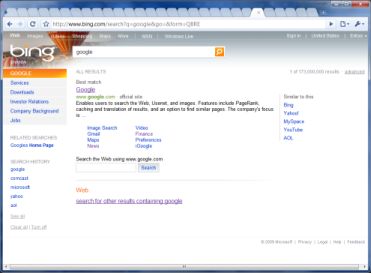
For instance, Googlewhack has always been a fun past time (find a search term of two words or less, that resolves to one and only one result) - and its fairly tricky to do (check out the site for details) - on Google.
But with Bing.... not so hard! Turns out that searching for a competitve search engine (Google, Yahoo, AOL, etc). is a googlewhack, um, bingwhack.
I'm (pretty) sure that the algorithm is NOT based on that fact - but that it appears so is, well, so Microsoft smelling... try it yourself.
Bing!

May 20, 2009
Browser benchmarks: When did they get so stupid?
So, the claim that IE is faster than Firefox, Safari, or Chrome, is ridiculous at many levels (MS claims IE faster than other browsers), and Microsoft was appropriately ridiculed for it.
But so is the idea that you have a test that demonstrates that the new Safari builds are "above 15 times better performance than Internet Explorer 7 in the same system".
Seriously, that's just stupid., and renders the index meaningless.
Why not just multiple the index scores by 10? Then you can claim Safari is 150X faster than IE7.
Without scaling the index into a range that meaningfully communicates (or at least correlates) to user experience (which things like FPS and even 3DMark did for video cards), it renders the testing both invalid and irrelevant.
May 15, 2009
Comscore v. Hulu: garbage in---garbage out?
Interesting. The New York Times is reporting that Hulu is disputing audience count with Nielsen, stating "While Nielsen reported 8.9 million visitors to Hulu in March, another measurement firm,comScore, counted 42 million. "
Wow.
Slightly embarassing, but I think that the Times is confusing "Unique Visitors" (how many unique cookies are counted by a site - a reasonable proxy for people visiting the site) with "Unique Viewers" (a syndicated video player concept - how many unique cookies were counted by the syndicated player; a reasonable proxy for the number of viewers who were served video by the site).
In layman's terms, the first number would represent, in our example, the number of people who visited Hulu.com (unique visitors), while the second (unique viewers) would represent how many people watched a Hulu sourced video, whether on Hulu, a third party site (like Fancast), or embedded elsewhere (like on somebody's blog).
A visit to alexa or compete shows the number of "unique visitors" to be comparable to what Nielsen reported (a fact others have noted). And guess what? Even Comscore doesn't put Hulu in the top 50 for April 2009 - which means even Comscore suggests that the number of unique visistors to Hulu is less than 19M (if someone has the actual number, I'd appreciate it).
So... move along... nothing to see here...
April 26, 2009
Wow - what am I missing?
Pirate bay craziness...
http://www.nme.com/news/various-artists/44103
The pirate bay is (was?) a site that holds *links* to torrents. I'm NOT in anyway in favor of copyright violation or intellectual property theft - but how is this (a) wrong or (b) worthy of the punishment? ($M in fines, and time in *prison*)??
Its a search engine? It doesn't hold the content.... perhaps I'm missing something (have to admit I never used it).
Update: hiliarious (and accurate) thepirategoogle (pirate bay using google... duh, its a search engine, just like thepiratebay was)
Update 2: hmm - broken (blocked by google?)
Update 3: An update (tried to find the site owner, but couldn't)... so try this: thepiratebaygoogle on sree
Subscribe to:
Posts (Atom)